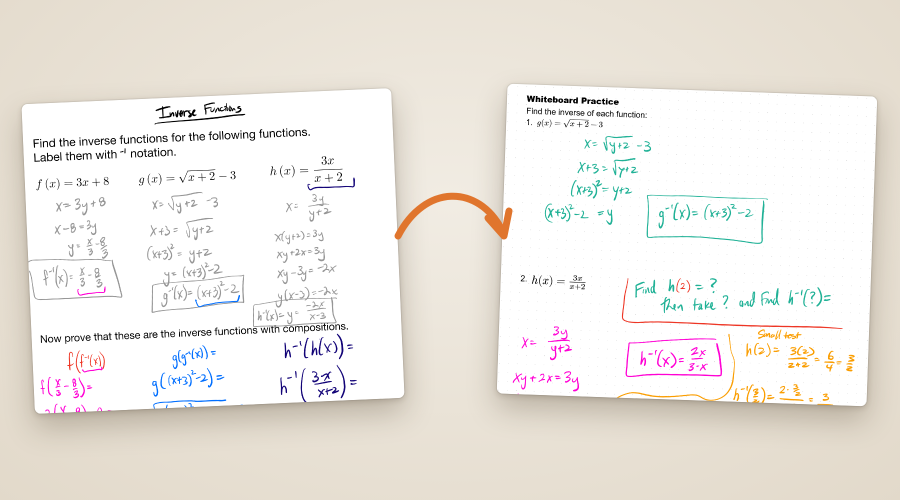
Back in June I wrote a post about rebuilding my precalc notes with an AI agent. At that point it was just an idea. Two months in now. Time for an update! I have three preps across five classes, and on any given morning I'm trying to remember where each class actually is. Did we finish the examples last class, or did I run out of time? I've taught some version of these courses for over a decade, and it's still difficult to keep all this in my head. So I gave my old handwritten note files and my pacing to Claude Code and asked it to keep track of nearly everything for me. (Tool note: the summer work started in Google's Antigravity. I moved to Claude Code in July.)
The old way: Notability
For years my notes lived in Notability, one note per day, with three copies so I could mark one up for each section. Small changes were easy enough, like swapping the numbers in an example. Anything bigger, like moving a chunk of one lesson into another or reordering a unit, was a whole project, because everything was stuck on the page it was written on. So mostly I didn't make the big changes. The courses got a little better each year.
What changed
Every lesson is now a Markdown file with text, equations and graphs, and a (Claude Code written) script turns each one into two files. One is a Notability notebook (.ntb) that I import and write on during class. Since it's a real notebook file, I can still grab text, equations and pictures and move them around mid-lesson. The other is a teacher key PDF with the answers, which I print out for myself.
That makes the big changes cheap. When I want a unit checked for errors, pacing, and topic order, Claude Code sends back a note with a checkbox next to each change it suggests. I check the ones I want and it makes those changes, or I push back with a different solution.
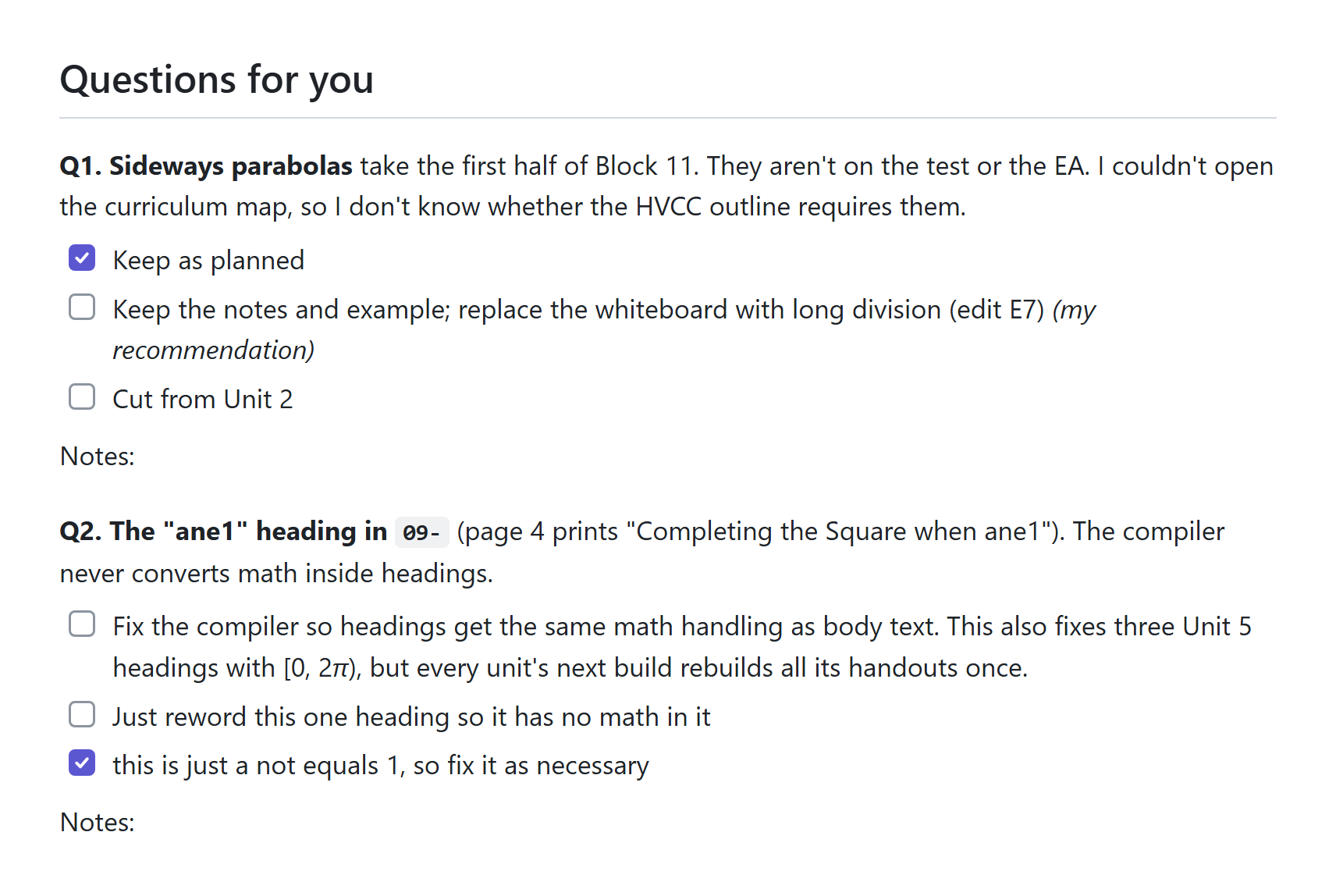
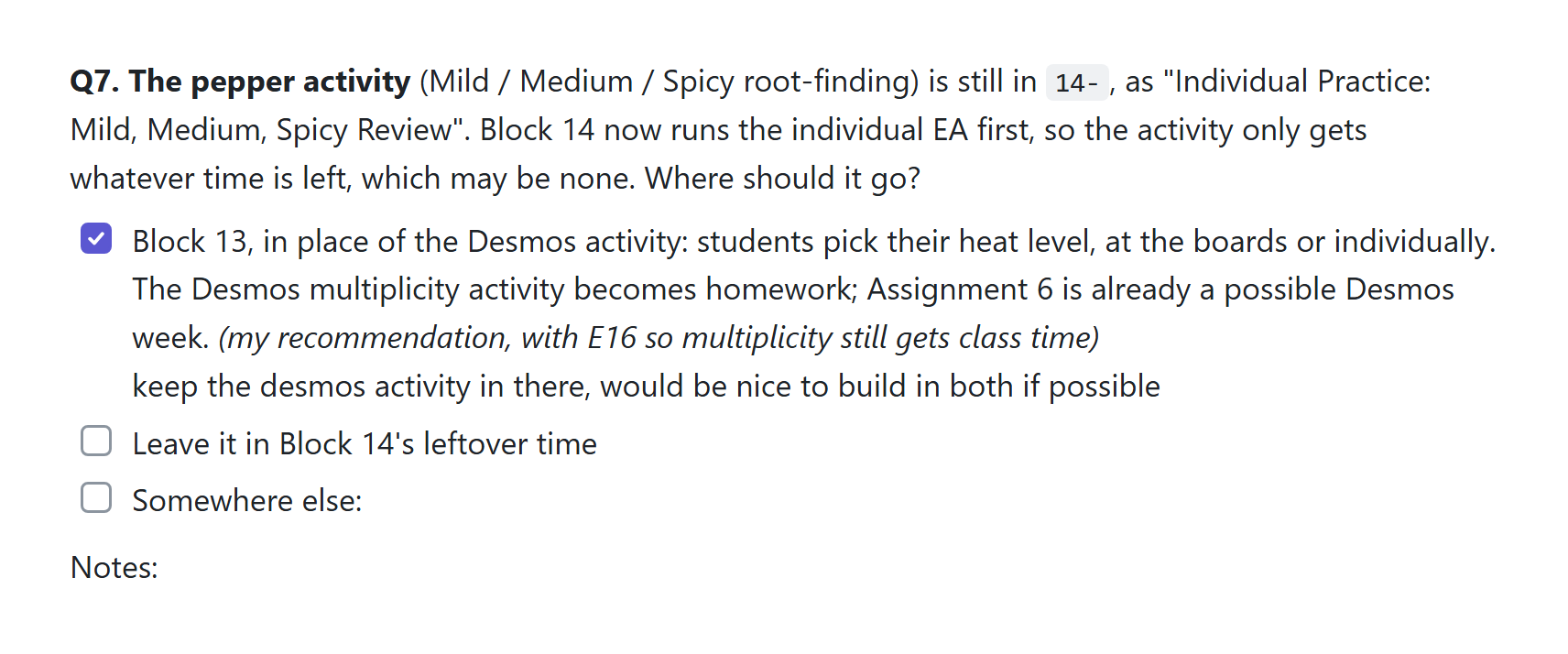 It also knows my week. Before class I ask it "what's the plan for today?", and after class it reads the notes I wrote on in Notability and logs how far each section got.
Spiral review
Weekly homework is with DeltaMath, but I always did a pretty lousy job with spiral review. I could never keep track of what we'd circled back to and what had fallen off.
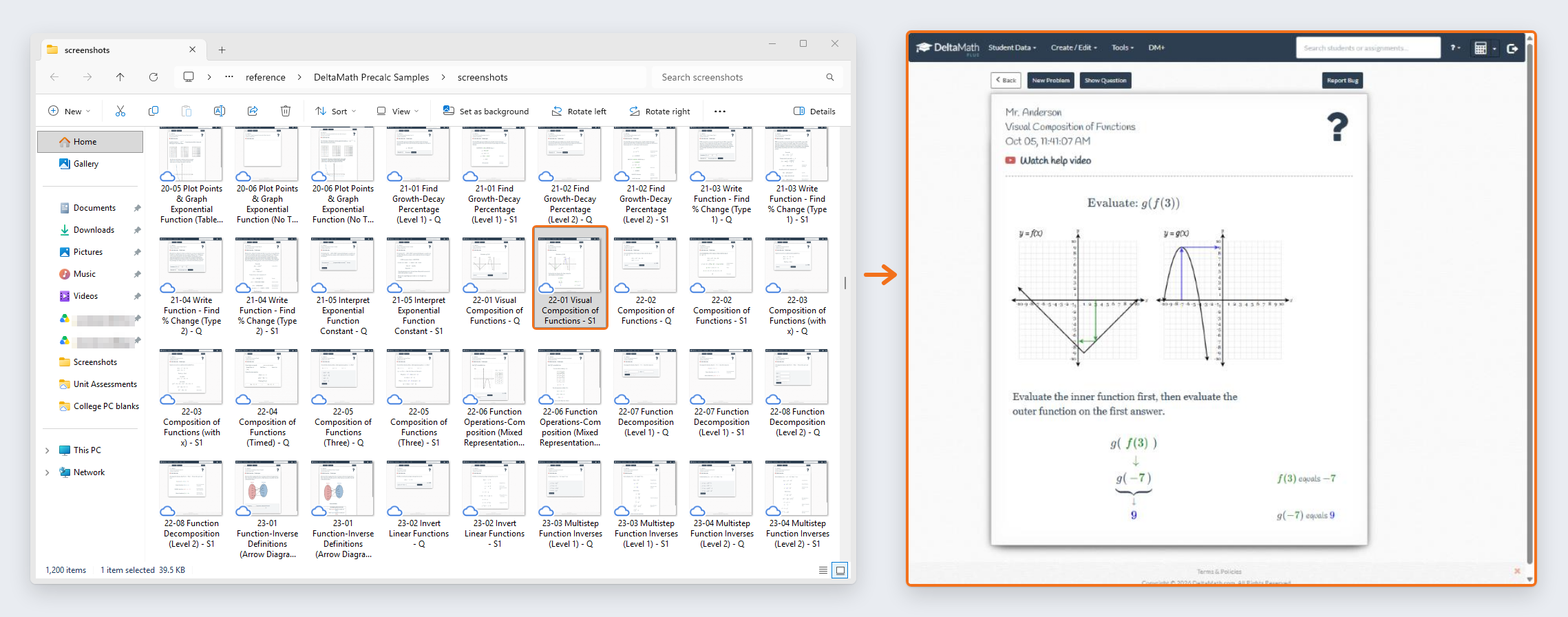
So I pulled the full standards list off DeltaMath, and Claude Code grabbed a picture of every problem type and put them in a database. It tracks what we've reviewed this year, what we haven't, and what's worth previewing before we get there.
 Say I'm walking around during group work and notice three groups are fine factoring quadratics until a > 1. The old version of this was a Post-it: "harder factoring next week," stuck on the front cover of the iPad, and then I had to remember to go do it later. Now I take thirty seconds at the computer and tell Claude Code this class is shaky on factoring with a > 1. That goes into memory, and the problem type shows up in next week's homework and keeps showing up for a few weeks after. It's the closest thing I've had to a TA.
Is the spiral review working? ¯\_(ツ)_/¯. Too early to tell.
Block one, then block two
Sometimes the fix can't wait until next week. Halfway through block one I'll notice an example isn't landing. I type a quick note and keep teaching. Claude Code edits the lesson and rebuilds the files in the background, and by block two the fixed version is ready. Now the second section of the day gets a better version than the first section did. The feedback loop went from twelve months to about forty minutes.
Where it breaks
The first homework planner, built in Antigravity back in June, hallucinated DeltaMath skill names. The rebuilt plan only pulls from DeltaMath's actual catalog (1,374 skills) and my own assignments from last year. The student-facing stuff is where I trust it least. Claude Code built a MagicSchool review tutor for my AP CS Principles class and then pretended to be a determined student against it. The first version gave up a pasted quiz answer after one follow-up. So the tutors never see actual assessment content anymore. That said, the hallucinations have dropped dramatically over the past year. The models I've been using are really good math and CS students.
Snapshot of My Interactions
A few things I typed into the chat window over the past month:
- “what’s on tap for today, give a check over the notes to make sure things look good”
- “also pacing was off, we didn’t get to finish the anchor example, and I had to add in a spot to put the crossover point notes.”
- “dude, on 16 you still asked for “holes” but we haven’t gone over holes yet.”
- “can you do a deep dive on why this unit was such a hot mess? Was it because you made the plans without knowing what was on the assessment? And also didn’t look at my notes from the previous year?”
- “ok, there is WAAAAY too much text describing every step in the EA for unit 3.”
- “reverse engineer the format is fine with me”
- “in the future if we have problems like this (given a students’ work answer questions) just remember to remind me to complete the work”
So Where Are We? And Who Should Do This?
The experiment has been off to a good start. I truly think that the students this year are getting a higher quality education than in the past. I spend more time on planning, but less time on the minutia of the planning. Who should do something like this? How do we use AI but not let it take over the critical thinking? I think this has been a successful project for me because I'm an experienced teacher and I have developed a sophisticated "taste" for what good teaching/learning looks like, and that only came from years of doing things the long way. A teacher probably doesn't have to wait until 20+ years into their career like me. But should they be using AI in their first five years of teaching? I can see ways that inexperienced teachers CAN be successful by using AI to give them feedback and to suggest changes to what they're doing. But I can also see an (in)experienced teacher make the AI slop version of lessons if they don't come to the table with a strong opinion on what makes a good lesson.